
Married by Powers
TENT., Rotterdam
2002
Married by Powers explores the nature of museum collections through the lens of Gustave Flaubert’s Bouvard and Pécuchet, where two obsessive collectors amass objects ranging from menhirs to pharmacy pestles, attributing universal meaning to them. Their museum becomes a phallic symbol of control, yet it ultimately reflects the absurdity of trying to represent the entire universe through fragmented artifacts. When confronted, the collectors shrug off objections, embodying the delusion that their collection constitutes a coherent worldview. They argue that museums sustain themselves through the fiction that their disparate items form a meaningful whole, when in reality they are often just a bric-a-brac of valueless fragments substituting for deeper representation.
Invited to work with the collection of FRAC Nord-Pas de Calais, Bik Van der Pol approached the task with a critical eye toward cultural production. They view museum collections not as static treasures but as tools with potential for social resistance or commercial exploitation.
Their perspective aligns with the idea that collections are “activated” and “revitalized” only when taken into operation, transforming them from dormant storage into “working papers” at large that influence vision and perception.
Married by Powers revealed the hidden aspects of collections: transport, storage, presentation, documentation, mediation, and personal interpretation. It aimed to create a “literal tank” of cultural production, where objects become active participants in shaping contemporary understanding.
Married by Powers featured around 150 works by 73 different artists, selected based on criteria such as widespread recognition and the ability to spark dialogue. Van der Pol sought works that aroused personal dialogue between them, and that they were eager to see in real life, sometimes having only known them through media images or stories.
Some practical constraints limited their choices: when works were unavailable due to concurrent exhibitions, or too large or complex to transport or install. Also, the total exhibition length was limited to 30 days. This highlighted the tension between the theoretical unlimitedness of a collection and the logistical realities of curation.
Bik van der Pol also invited nine partners, all young colleagues, active in the wider art world. They – the cultural creators of tomorrow –made a selection from the 150 works and were asked to motivate their choices. Each selection is exhibited over three days, resulting in nine individual exhibitions.
Some pieces are shown more frequently, in a different context and certainly with a different rationale.
Their motivations have been recorded on video and shown, creating an ever-expanding discursive ‘shadow collection’ that engages in dialogue with the collection as a whole on display in the storage, whilst creating links with the exhibited selections that constantly changing each three days.


Three pieces are shown during the whole period: How Does It Feel (1995), a work of Tony Oursler addresses directly to the viewer, exploring and questioning the relation between public and private, intimate space. With Speech Bubbles (1997) by Philippe Parreno, the energy of a discourse floats - so to speak - in the air. Untitled, 1994 (Recreational Lounge) by Rirkrit Tiravanija, consisting of a football game, a fridge with drinks, a couch, a table with selected reading material on exhibitions in Rotterdam and a Warhol silk print creates a place in the exhibition, actively inviting the public to play, hang out, think and read.
Married by Powers raised critical questions about the significance of an international art collection in a changing world.
What does it mean for individual pieces to determine our collective vision? How can a collection be valued beyond the cyclical nature of exhibitions and publications? The project explored what these objects mean to younger generations of artists, designers, and architects, suggesting that collections hold potential for activation beyond traditional display. The accompanying depot report underscored the reality that most of the collection remains hidden in cellars, rarely seen and often forgotten. When displayed, it is usually in small fragments, further emphasizing the gap between the myth of the cohesive museum and the fragmented reality of its holdings.
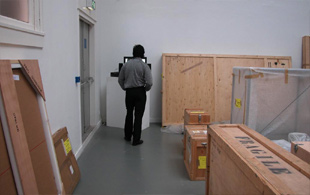
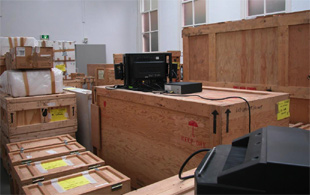


Bik Van der Pol critique the museum’s role in perpetuating the illusion of coherence. Just as Bouvard and Pécuchet shrug off objections to their absurd collection, museums often ignore the contradictions and gaps in their narratives. Married by Powers sought to expose these contradictions, making visible the processes that typically remain concealed. By focusing on the logistical and interpretive layers of collection management, it challenged viewers to reconsider the authority and meaning of museum objects.
In essence, they argue that museum collections are not neutral repositories but active constructs shaped by choices, constraints, and ideologies. The exhibition served as a meta-commentary on these dynamics, inviting reflection on how collections are built, maintained, and perceived. It questioned whether the value of a collection lies in its individual pieces or in the stories and systems that surround them.
Ultimately, Married by Powers aimed to transform the collection from an archive into a dynamic resource, capable of engaging with contemporary issues and future generations.
Married by Powers happened thanks to the dedication of all who contributed: Lisa Klapstock, Natasa
Petresin, Basak Senova, Mai Abu Eldahab, Franceso Bernardelli, Nikola Dietrich, Edit Molnar, Marc Bijl,
Maher Al Sabbagh, Paulina Olowska, Jill Magid, Nanine Linning, Martijn Boelhouwers, André van der Eijk,
Carla Cruz, Nina Hoechtl, Tina Sejbjerg, Claudia van Dijk, and Reynaldo Chirino; and Ad Benard (research);
Roebie Starink (video work) ; Peter Westenberg (design invitation); NienkeTerpsma (design poster); the team
of Frac Nord-Pas de Calais in Dunkerque and TENT. in Rotterdam; transport LeClerq and AFAA, Association
Francaise d'Action Artistique.


Themes: